Get Me A Chiya
A Nepal-focused digital tipping experiment built to explore eSewa wallet integration, payment workflows, and transaction handling in a full-stack web application.
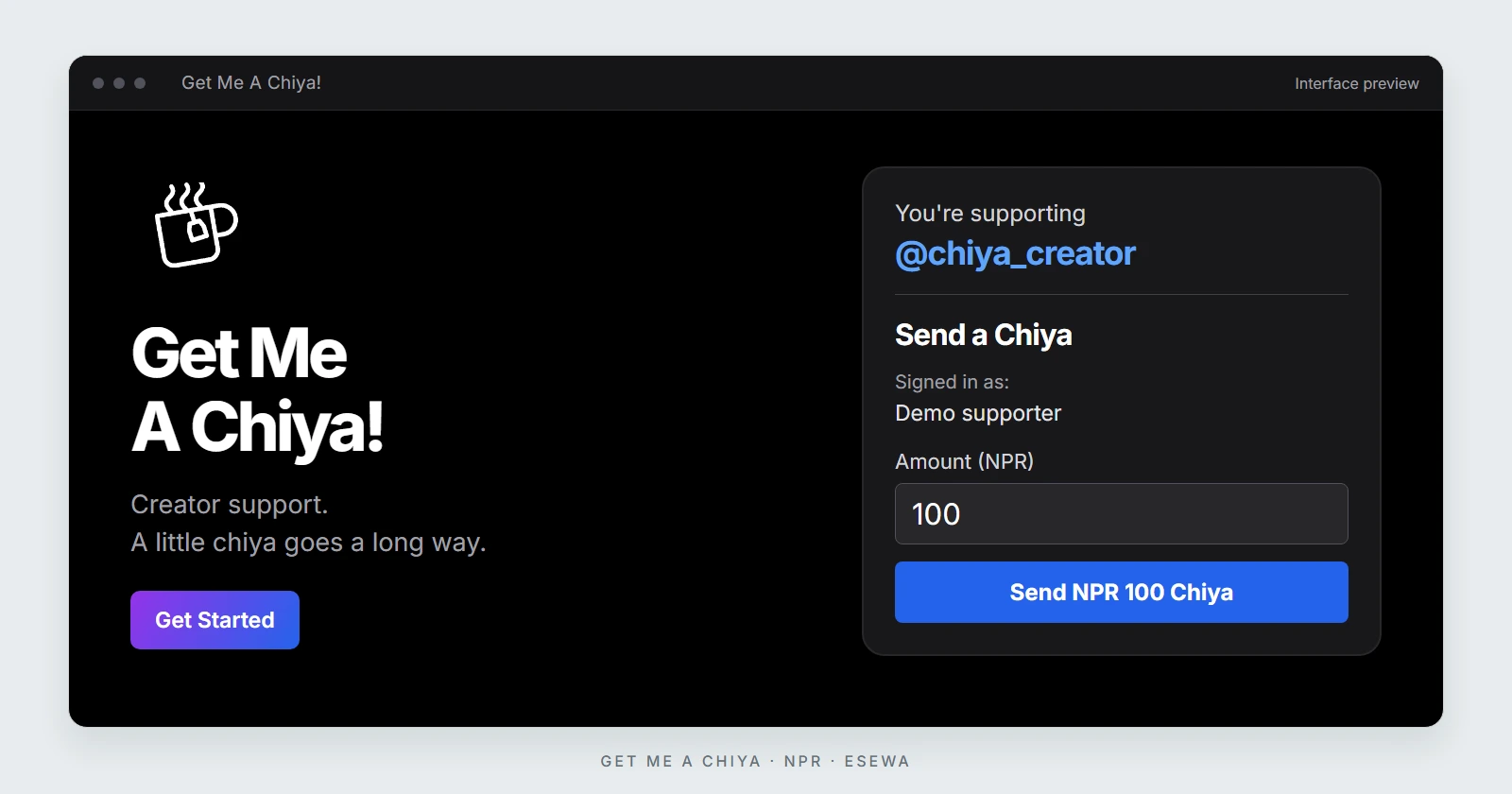
A reason to build
Integrating digital payments involves more than redirecting users to a wallet. Applications need to manage transaction identifiers, payment states, gateway responses, and the relationship between a payment and the user who initiated it. This project explores those challenges through a simple digital tipping concept.
What I worked on
Independently developed a Next.js application to experiment with integrating Nepal's eSewa payment gateway. Explored authenticated user flows, database-backed application state, and the technical requirements of connecting an external wallet service to a web application.
How the pieces fit
- Built the application using Next.js and JavaScript.
- Used Clerk for user authentication.
- Structured database access using MongoDB and Mongoose.
- Explored eSewa payment initiation and gateway integration.
- Studied transaction identifiers, payment responses, and verification requirements.
- Developed a lightweight tipping concept to provide a practical use case for payment integration.
The detail that matters
Chose eSewa as the payment provider to gain hands-on experience with a widely used Nepali digital wallet. Used a simple tipping application to keep the product scope small and concentrate on understanding the payment integration process.
Where it stands
Created a full-stack learning project centered on eSewa wallet integration. The repository documents an early exploration of payment workflows using Next.js, authentication, and database-backed application architecture.
Developed a stronger understanding of third-party API integration and the complexities of payment processing. Learned why payment status must be verified through trusted server-side mechanisms rather than relying solely on client-side redirects or success messages.
GetMeACoffee CLI
Have a useful problem to solve?
Let’s talk